Overload relay
Protects a motor from sustained over-current by tripping the control circuit if it runs too hot for too long.
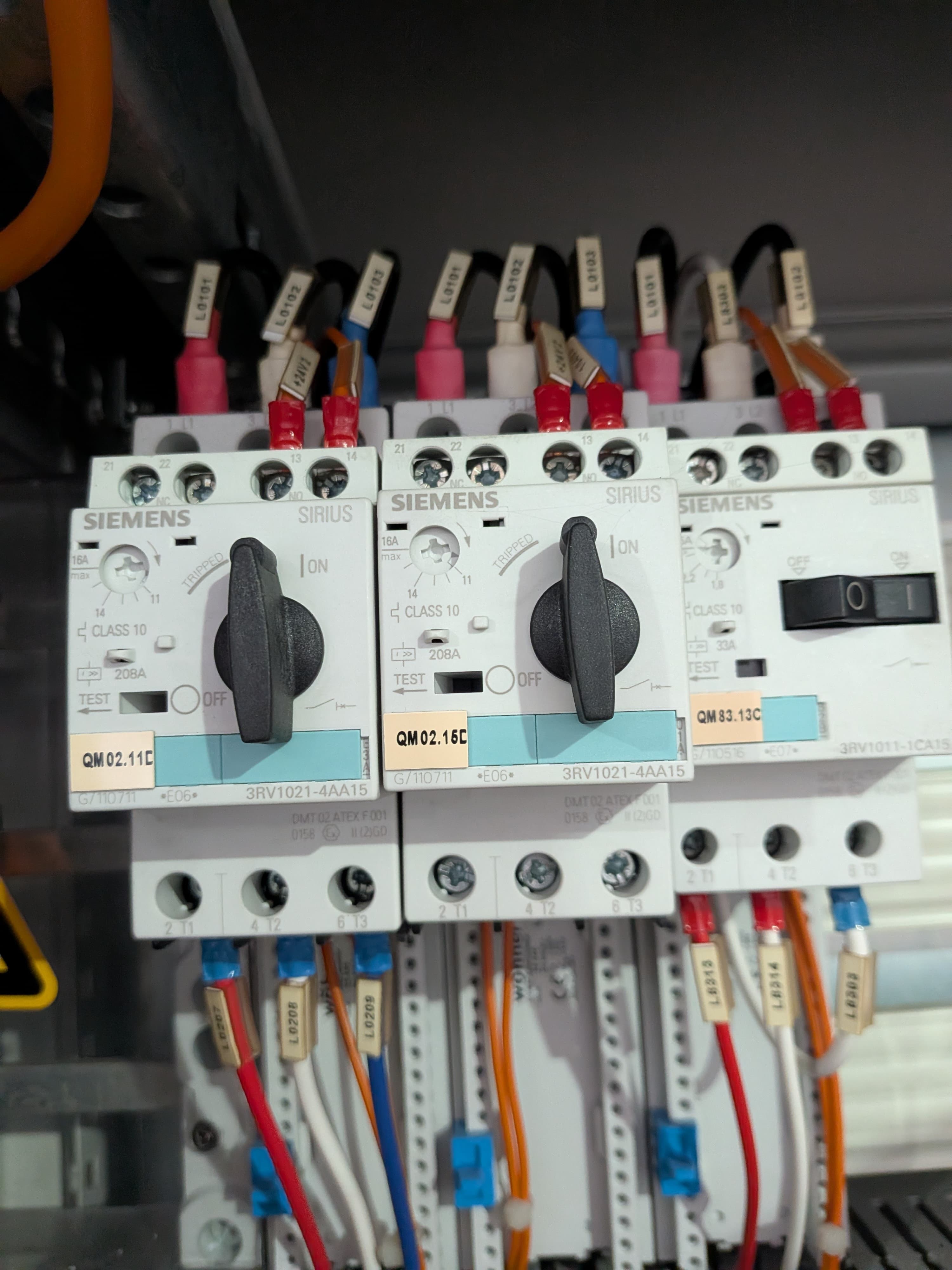
What it is
An overload relay protects a motor against sustained over-current — the kind caused by a jammed load, single-phasing, or a motor working too hard. It's set to the motor's full-load current.
How it works
A thermal overload passes the motor current through bimetallic strips. Excess current heats them; they bend, and after a time delay they operate a contact that breaks the contactor's coil circuit — dropping the motor out.
The time delay is deliberate: it rides through the brief high current of starting but trips on a sustained overload. Electronic overloads do the same job by measuring current directly.
Where it's used
Fitted to almost every motor starter, between the contactor and the motor. It's set (in amps) to the motor's nameplate full-load current.
If it keeps tripping, it's usually protecting against something real — don't just wind it up. Causes include a mechanical overload, single-phasing, a winding fault, or a setting that's too low.
What it looks like when it fails
Most 'faulty overload' calls aren't the relay: repeated tripping is usually single-phasing, a mechanical overload, or a dial set below the motor's FLC. Genuine relay faults look different — the trip contact (95–96) goes open or dirty so the starter won't pull in at all, or the mechanism sticks so pressing reset never re-makes the circuit.
Thermal types can also fail with an open heater element: control circuit perfect, contactor pulls in, but one motor phase is dead through the overload — single-phasing the motor through the very device meant to protect it.
How to test it
Dead: continuity across 95–96 — closed when healthy and reset, open after a trip (97–98 is the mirror NO contact, usually for a trip lamp). No continuity through 95–96 with the relay reset condemns it. While you're there, check continuity pole-to-pole through the heater path.
In service: check the dial against the motor's nameplate FLC, then clamp the actual running current — a motor drawing 8 A on a dial set to 6 A is not a faulty overload. Most relays have a test/trip button: use it to prove a trip actually drops the contactor.
Gotchas
Set it to the motor's FLC — not the breaker size, and not 'a bit higher so it stops tripping'. Winding the dial past nameplate removes the motor's only overload protection and cooks it slowly.
Auto-reset plus a 2-wire (maintained) control circuit means the machine restarts itself once the relay cools — keep hand-reset unless the design genuinely calls for auto. And trip class matters: a Class 10 relay on a heavy, slow-starting load trips on every start. That's the wrong class, not a bad motor.
Safety first
A tripping overload is protecting the motor — find why before resetting. Resetting can restart machinery.
Isolate, lock out / tag out, and prove dead before working unless a live test is specifically required, authorised, and carried out under proper supervision. Always follow local regulations, your site procedures, and the equipment manufacturer's documentation.
Related faults
Motor overload keeps tripping
The thermal/electronic overload trips repeatedly, either on start or after the motor has run for a while. Resetting only buys you a short run before it trips again.
Overload relay won't reset
After an overload trip, the reset won't take — the starter won't re-arm, or it resets and trips straight back. The control circuit stays broken at the overload's contact.
Three-phase equipment single-phasing (lost a phase)
Three-phase equipment is misbehaving — motors humming, struggling, overheating, or tripping — because one phase has been lost somewhere between the supply and the load.
Related definitions
Induction motor
The workhorse AC motor — a rotating magnetic field in the stator drags the rotor around with it.
Contactor
An electrically-operated switch that uses a coil to make or break a load circuit, usually three-phase power.
Circuit breaker (MCB)
Automatically disconnects a circuit on overload or short circuit, and can be reset rather than replaced.
Start/stop circuit (seal-in)
A momentary start button that latches a contactor on, held by its own auxiliary contact until stop is pressed.